The Legal Dollar is a great blog. For those of you who sometimes (or often) think the "Scam Busting" blogs are too filled with hyperbole for your taste, TLD is less geared towards law school bashing and more towards personal financial decision making for lawyers/law students. (Though the best financial advice would probably be don't go into debt in the first place to attend law school.)
Recently, the blog had a good post about the financial risks associated with enrolling in law school. One thing that caught my eye was the following anecdote:
When I mentioned that I worked with a lot of young lawyers and the job search was becoming more difficult, one of the potential students interrupted me and said very loudly and bluntly "That's not true." (Wilson's outbust of saying "You lie!" during an Obama speech had happened not too long before, so I got a little sense of something like deja vu.)
I assured the student that I had been working with recent graduates for several years and the task of helping them get jobs had indeed become more difficult in recent years. They countered by saying that my comments were not in accord with what they were seeing in law school admission materials. To this I suggested that they might want to drill down a little with regard to what a "90% employment rate after graduation really meant."
They also preferred to believe the numbers put out by the law schools with regard to starting salary. They did not even want to believe the NALP median numbers and started trying to suggest to me reasons why the NALP numbers must be wrong.
Ah, the arrogance and naivete of the prospective law students. How sad that one day, with their hopes of living a stable lifestyle thanks to an advanced degree dashed, they too will lash out at the scam only to be admonished for their "lack of research" and "entitlement mentalities".
Nonetheless, I can only be so harsh towards these sorry lambs being led to the slaughter. You see, sadly, I too was once like them. I don't think I ever thought that six figures was in the bag just because I was able to sign my name to the check for my seat deposit (and a subsequent promissory note). I did, however, believe the data about the median starting salaries. I thought the employment figures were accurate. I even believed that my law school was interested in providing practical training and that its proximity to many large firms and businesses would give me numerous employment options.
Most embarrassingly, I even believed that my school's career service office had any real interest in helping me actually secure a career.
It's really a good thing I'm not a woman. Otherwise, I'd probably take every half soused goon at his word that he's really an internet-start-up tycoon even though he drives an '85 LeBaron and lives in a studio apartment on top of a bowling alley.
More than just accepting the distorted marketing materials produced by the schools (and industry publications), I also never really liked the occasional naysayers that popped up on discussion boards like Law School Discussion.
Back when I was applying, there wasn't nearly as much anti-law school information as there is now. It wasn't until after I started school that the infamous Wall Street Journal article came out where Law is 4 Losers and Loyola 2L were quoted and where a number of law school administrators admitted their statistics were based upon partially reported data.
In fact, I don't think it was until after I was already enrolled and taking classes that anti-law school advocates starting aggressively encouraging students not to attend law school (particularly the TTT's). This is when I was exposed to the infamous chart I printed earlier (reporting high salaries for some, low salaries for many, and middle range salaries for few). This is when I first heard about students from tier 2 and even tier 1 schools struggling to find substantive legal work (pre-recession). This is also when I first heard about the subterranean document review sweat shops.
As I mentioned, I was pretty incredulous of these claims. Surely, I thought there couldn't be that many students who resent going to law school. Those who were in document review must have just gotten in over their heads with debt and/or wanted an easy way to make some quick cash. It couldn't be true that so many students who missed the OCI cutoff had few other options for permanent employment other than toilet law or abandoning the field altogether. Surely, those people who took low paying, miserable firm jobs were people who were unwilling to leave the greater NYC metro area.
Moreover, the few anti-law school advocates with whom I came into contact did not come across well. One poster on Law School Discussion who went by the moniker "Wiimote" (referring to the Nintendo console) repeatedly posted on the message board that anyone who goes to law school is going to get hosed. I don't really disagree, but he never bothered putting his remarks in context. (Did he even go to LS?) He also never bothered engaging anyone who had any serious questions for him.
I don't know if 0L's currently deal with people employing similarly ill-advised tactics. Perhaps some of them see current anti-scam bloggers that way. When I've (rarely) ventured into the pre-law forums, I have tried to be as non-combative and charitable as possible. Nonetheless, like a sober man trying to deter an addict from continuing in his vice, I've been swatted away by the very people I'm trying to help.
Despite my differences with the OL's, I recognize that I was once like them. Still, for those of you considering law school, please realize that you can one day be like me.
It's easy to be incredulous of the idea that law jobs are hard to secure outside of OCI. You may be convinced that you'll never end up in document review. You might believe that you'll have the skill and savvy to go solo from the start, and of course, if all else fails that you'll know how to spin your law degree to help you land a solid non-legal job.
It may seem that way from where you're currently sitting. I thought so too.
Now, however, I know that going to CLE's and receptions gets you at best "well wishes" and at worst brushed off - certainly not solid leads for jobs. I've diligently scanned the job boards finding plenty of positions for legal assistants but precious few for practicing attorneys (and almost all at pay well south of $50k). I've personally investigated going solo from the start only to realize the expense of starting a legitimate practice and the difficulty of independently learning the necessary law and procedure while making enough to survive.
I've been referred to attorneys only to either get blown off or to learn that they simply can't/won't hire additional associates for their small firms because it's not economical. I've been unable to work with other contacts because their firms/organizations simply won't hire me because I didn't go to the right school or make the top 10%.
Right now, I'm even being strung along by temp agencies with the possibility of getting hired for JUNIOR document review positions.
Of course, I've sent reams of resumes and cover letters to non-legal employers with nary a response. Not only do I have an undergrad business/econ degree and a tech background, but I also worked for two years. I've applied for a number of positions that were actually related to my responsibilities at my former job and couldn't even get interviews.
Also, if you think I didn't have much of a candidate profile before law school, you're wrong. As I've mentioned before, I only searched for jobs for a few months post-college and had a number of interviews, multiple offers, and accepted a job for a position in which I was one of a hundred candidates. I don't say this to brag; I say this to assure you that the "x-factor" here is my law degree/three year experience gap.
Obviously, when I "open up" like this, I'm inevitably going to get a comment about "whining". I don't say this to elicit your pity. I say this because this is the frustration I (and many, many other law graduates) have experienced first hand. I didn't believe the warnings before or even during law school. Now I have no choice but to believe them. I'm living them.
Unless your personal goal is to also have an anti-law school blog on blogger.com one day, trust me this is a warning, not whining.
Wednesday, January 27, 2010

Monday, January 25, 2010
Honesty is the Best Policy
You don't need to tell me how frustrating it is to find a job when you have a J.D. When you throw in the lousy economy and the fact that I'd like to find a somewhat respectable non-legal position (for which I'm supposedly "overqualified"), the situation is downright maddening.
I've written before about the great dilemma: whether to remove the JD and have a gap in experience on your resume or keep it on and be dismissed as over-educated before you can even get an interview.
This isn't a pretty choice, and veering in either direction can leave you unemployed and without any interviews. It's particularly bad if all of your professional experience is law related. I can imagine that if you've actually worked in law for a few years, dropping your JD, etc. from your resume isn't even an option anymore.
This situation leaves the job applicant with a strong temptation to lie. I've joked about this in the past, but it was only a joke. Lying on your resume is a bad idea.
This doesn't mean you can't skillfully market yourself. Only including relevant education and work experience (as long as it's labeled as such) is fine. After all, if you have a computer science degree and you're applying for a programming job, why include the JD if it's not at all relevant? If you were treasurer of both a controversial political club on campus and later the treasurer of your student government, you may want to include the club only if you're looking to work for a like minded organization and just mention your time as student body treasurer for all other positions.
Lying, however, will get you into trouble. Interviewers may eventually push you to bring up your JD or any other aberrations they see in your resume. If they do, be honest and explain away these issues as best you can. (I provide a hint for dealing with the JD in the post I linked to above.)
Moreover, lying out of the gate is even a worse idea. Once you go down that road it'll be hard to stop yourself before you're caught. What are you going to do, extend the date for which you worked for a company through law school? What if they call your former employer? Not only will you be busted by the potential employer to which you're applying, you'll ruin your good name with (and likely future references from) your former employer as well.
Are you going to make up a job? Do you plan to give your friend a cell phone and ask her to greet everyone with "Vandelay Industries!"when it rings? (This didn't work out too well for George Constanza.) This is the age of the internet; are you going to build a fake website for your fake company? Don't even think about using a real company when all of their contact information is available online.
Are you going to claim that you spent the last three years caring for a sick relative, backpacking through Europe, or helping out poor people in a foreign land? Not only is this particularly sleazy - not only lying about law school but also emphasizing altruistic personality traits you clearly don't have -but you'd have to find a company that would value this sort of experience. Most hard nosed corporations aren't looking for "free spirits" who decided to live abroad for three years to forgo being in the workforce.
Plus, wouldn't such avenues (at least in the latter two cases) naturally lend themselves to some stories in which your co-workers may take an interest? You better hope you can keep your story straight.
"So, Ralph what was it like to travel around Europe for three years?"
"Oh, it was great - I went to London, St. Petersburg, and Sydney."
"Uh, isn't Sydney in Australia?"
"Oh, I meant, uh, Sydney, Italy - it's a small town with, uh, good pizza...Speaking of which, who wants to get a slice?"
This also alludes to an additional problem - keeping the lie going. Don't other people know you went to law school? Better hope you can keep your parents, classmates, and (yikes!) exes away from your boss. Are you just going to continue on for years at a company telling tales about what you did during your three years "not at law school" and be able to keep your mouth shut any time a legal topic or (heaven forbid!) the issue of law school comes up? What if there's a job or promotion available where having work experience and a JD would be an asset?
Sure, this could make for a funny sitcom. (Hmm, NBC, call me. This can't be worse than the junk you're currently airing.) Nevertheless, it won't be very fun in the real world where you'll have to walk around on eggshells.
Also, don't forget, if you're a licensed attorney, you're still subject to discipline or disbarment for any misconduct you commit even outside of your role as an attorney. You may not care about practicing law, but having a professional license suspended or yanked isn't the sort of thing that you probably want on your record regardless of the jobs for which you're applying.
Above the Law recently reported that an attorney got busted for doctoring his transcript. He was later caught when he applied for jobs with his real transcript. Now, you may think this guy got sloppy. Maybe he did. There an old saw, however, that says: If you never lie, you don't have to worry about remembering what you said (or did) in the past.
We don't have much, my fellow law school scam victims, but let's at least keep our integrity.
I've written before about the great dilemma: whether to remove the JD and have a gap in experience on your resume or keep it on and be dismissed as over-educated before you can even get an interview.
This isn't a pretty choice, and veering in either direction can leave you unemployed and without any interviews. It's particularly bad if all of your professional experience is law related. I can imagine that if you've actually worked in law for a few years, dropping your JD, etc. from your resume isn't even an option anymore.
This situation leaves the job applicant with a strong temptation to lie. I've joked about this in the past, but it was only a joke. Lying on your resume is a bad idea.
This doesn't mean you can't skillfully market yourself. Only including relevant education and work experience (as long as it's labeled as such) is fine. After all, if you have a computer science degree and you're applying for a programming job, why include the JD if it's not at all relevant? If you were treasurer of both a controversial political club on campus and later the treasurer of your student government, you may want to include the club only if you're looking to work for a like minded organization and just mention your time as student body treasurer for all other positions.
Lying, however, will get you into trouble. Interviewers may eventually push you to bring up your JD or any other aberrations they see in your resume. If they do, be honest and explain away these issues as best you can. (I provide a hint for dealing with the JD in the post I linked to above.)
Moreover, lying out of the gate is even a worse idea. Once you go down that road it'll be hard to stop yourself before you're caught. What are you going to do, extend the date for which you worked for a company through law school? What if they call your former employer? Not only will you be busted by the potential employer to which you're applying, you'll ruin your good name with (and likely future references from) your former employer as well.
Are you going to make up a job? Do you plan to give your friend a cell phone and ask her to greet everyone with "Vandelay Industries!"when it rings? (This didn't work out too well for George Constanza.) This is the age of the internet; are you going to build a fake website for your fake company? Don't even think about using a real company when all of their contact information is available online.
Are you going to claim that you spent the last three years caring for a sick relative, backpacking through Europe, or helping out poor people in a foreign land? Not only is this particularly sleazy - not only lying about law school but also emphasizing altruistic personality traits you clearly don't have -but you'd have to find a company that would value this sort of experience. Most hard nosed corporations aren't looking for "free spirits" who decided to live abroad for three years to forgo being in the workforce.
Plus, wouldn't such avenues (at least in the latter two cases) naturally lend themselves to some stories in which your co-workers may take an interest? You better hope you can keep your story straight.
"So, Ralph what was it like to travel around Europe for three years?"
"Oh, it was great - I went to London, St. Petersburg, and Sydney."
"Uh, isn't Sydney in Australia?"
"Oh, I meant, uh, Sydney, Italy - it's a small town with, uh, good pizza...Speaking of which, who wants to get a slice?"
This also alludes to an additional problem - keeping the lie going. Don't other people know you went to law school? Better hope you can keep your parents, classmates, and (yikes!) exes away from your boss. Are you just going to continue on for years at a company telling tales about what you did during your three years "not at law school" and be able to keep your mouth shut any time a legal topic or (heaven forbid!) the issue of law school comes up? What if there's a job or promotion available where having work experience and a JD would be an asset?
Sure, this could make for a funny sitcom. (Hmm, NBC, call me. This can't be worse than the junk you're currently airing.) Nevertheless, it won't be very fun in the real world where you'll have to walk around on eggshells.
Also, don't forget, if you're a licensed attorney, you're still subject to discipline or disbarment for any misconduct you commit even outside of your role as an attorney. You may not care about practicing law, but having a professional license suspended or yanked isn't the sort of thing that you probably want on your record regardless of the jobs for which you're applying.
Above the Law recently reported that an attorney got busted for doctoring his transcript. He was later caught when he applied for jobs with his real transcript. Now, you may think this guy got sloppy. Maybe he did. There an old saw, however, that says: If you never lie, you don't have to worry about remembering what you said (or did) in the past.
We don't have much, my fellow law school scam victims, but let's at least keep our integrity.
Friday, January 22, 2010
Pride and Prejudice
"It is a truth universally acknowledged, that a single man in possession of a good fortune can easily blow it by going to a TTT law school."
Okay, well, maybe that's not how Jane Austen's most famous literary work begins. I wouldn't know. I was assigned to read this grandmother of all chic lit back in high school in my senior year English course, but I never actually got around to completing the assignment.
Why am I telling you this? Well, the senior year English course in which I enrolled was an AP course. This was the last time - prior to law school - I both overestimated my academic aptitude and the benefit of being in a "prestigious" program.
For those of you who think this blog entirely ignores the consumer side of the law school scam, this post is intended to address the 0L mindset's role in this national debacle. I've written in the past how law school admittees can be compared to infomercial scam victims - sympathetic characters, but not entirely without blame.
I, of course, am not excusing the conduct of the law schools and company. As I've mentioned in the past, even if law school students are as unsympathetic as drug users, this doesn't absolve the schools from their culpability in taking advantage of the situation.
Returning to my English class example, as I mentioned, there are some parallels that exist between my decision to take AP English and to enroll in law school. I was under the impression that just because I had done well in previous English courses (including honors courses) prior to my senior year, I would do well in AP English. After all, I thought I was a good writer, liked to read, and had a robust lexicon.
Sadly, I was unprepared for the rigor of the AP course. The class required us to read full English novels and write 10-15 page papers on alternating weeks. This was in addition to the regular vocabulary, grammar, and other lessons we had to keep up with in the class. Of course, this was also on top of my course load of calculus and other AP courses as well as the little diversion of the college application process.
I'll be honest, folks; I had bitten off more than I could chew. This led me to hand in some*ahem* perfunctory papers and often fall behind with my reading (leading to some equally impressive reading quiz scores). Hence my failure to ever actually read the titular book associated with this blog post. (Hint to high school students: Trying to bypass reading the book by watching the BBC mini-series = a BAD idea; trying to sit through that sucker is worse than actually reading the darn thing.)
Now, of course, this post isn't really about that dreadful book. (So long female readership...) No, the title instead refers to a key problem for 0L's and law students: Pride. (I'm not sure where the prejudice comes in - maybe I should insert some Polish jokes.)
If you don't like my mangled quote from Jane Austen at the beginning, how about this verse from the Old Testament?
Pride goeth before destruction, and an haughty spirit before a fall. (Prov. 16:18)
Just like I thought my modest success in pre-AP English courses meant that I was prepared for the rigors of the class, I arrogantly felt that my undergraduate success, decent LSAT score, and interest in the social sciences would make me a successful law student. I would make the top 10% of the class, and even if I didn't, I'd be able to work hard in my internships and extracurricular activities and build an impressive resume that would afford me great employment opportunities.
If you've been reading this blog, you probably know this story turned out more like a Greek tragedy than an Austen novel where everyone lives happily ever after. It's not exactly "Oedipus marrying his mother" bad, but I'd say "I'm probably going to work doc review until they toss my corpse aside to make room for another coder earning $13.50 straight" bad is bad enough.
But I digress. You see, just because you earned a 3.9 in anthropology from a second tier liberal arts school where they wouldn't give a bag of lettuce less than a B+ in any given course, doesn't mean you're going to dominate your torts class. We're all real proud of you booking your "Feminist Mythology in Ancient Multicultural Societies" class, but I'm afraid that isn't going to prepare you for writing top notch law school exams.
For too many pre-law students, pride gets them into the law school mess in the first place. Everybody thinks they'll be in the top 10%. Even at schools where everybody is smart (save the truly elite institutions), only the best students will get the "good" jobs.
Another aspect of the pride principle is the average 0L's lust for prestige. Just like taking an extra AP course may have given the impression of a more elite transcript, earning a law degree from a good school is seen as quite the accomplishment by many. Sadly, getting a "C" in an AP course kind of takes the luster out of being in the top English class and being a permanent temp worker kind of tarnishes the old "Esq." title.
On virtually every pre-law message board, "prestige" is the key word. Everyone seems to think that going to a good law school (usually anything in the first two tiers) and eventually becoming a licensed attorney is the path to professional respectability. To be honest, many equally clueless people do regard law school and the title of attorney to be impressive. Trust me, they'll be less impressed when they learn that you're living under a highway overpass and the only thing between you and starvation is Burger King's recent decision to sell double cheeseburgers for a buck.
Of course, the problem with pride isn't limited only to the decision to go to law school. It also usually rears its head when it comes to the decision to stay in law school. To once again analogize LS to my ill fated enrollment in AP English, I actually had the opportunity to get out of my class.
There was an honors class that met at the exact same time my AP class met. I wouldn't even have to adjust my schedule, but I was stubborn and didn't want to face the indignity of being demoted from an AP to an honors class. (Though, in my defense, the students in the honors class had to perform in a play in front of parents and classmates. I don't have any problem with public speaking, but acting is another story. Esq. Never is also Thespian Never.)
Too many people in law school also fail to read the writing on the wall. Even though they're miserable, aren't in the top 10%, and don't even have much of a desire to become attorneys, they continue to plod along. This is part of the reason why the fallacy of the sunk cost is so powerful. Nobody wants to be labeled a "drop out" or "quitter". It's tough to give up on the idea that one may go through life without a coveted graduate degree. Nevertheless, that's simply pride talking. Ignore it. Pride may encourage you to move forward, but it's not going to be able to help you pay back those loans later on.
Worse yet is the idea that so many people think that they're the ones who can make it without top grades or great connections: I'll be on moot court; I'll be on a journal; I'll be on trial team; I'll flirt with the interviewers. Even if you do any of these things (and the last option isn't even available for graduates with 'Y' chromosomes), nobody is going to care. Law students with great extracurricular activities and internships are a dime a dozen.
Of course, if you do land a (non-OCI) legal job aside from document review after law school, it'll likely be for a low level firm that won't pay well or offer much opportunity for advancement - to say nothing about the lousy and unprofessional working conditions.
Here. once again, pride can play a role in making a ruinous decision. Everyone knows you're a lawyer, and everyone "knows" that lawyers are hotshots who make the big bucks. Clearly, you need to forge ahead and take any attorney position you can get just to save face.
Sadly, I haven't been able to check my pride until getting to this point and already doing some serious damage. Sure, working in a cubicle may not be fun, but it's certainly better than appearing in court during the day while living in a cubicle at night...and by a "cubicle", I mean a cardboard box near the subway.
Pride can take you to law school, keep you there, prod you into a depressing career, and eventually "throw" you off the GW bridge. I don't want to see that happen to any of you. Please quit while you're ahead...or at least before you entirely sink your life.
Tuesday, January 19, 2010
"Public Interest" - The Last Refuge of a Scoundrel
For those fearing a screed against pro-bono or public interest legal services, fear not. I put the term in quotes for a reason.
Martin Luther King day is often touted by some activists as "A Day On, Not a Day Off". (Thanks to law school and the recession, every day is a "day off" for me.) As my belated public service for the holiday, let me take some time to warn you about the tantalizing allure of going to law school to pursue a public service career.
You see, with an overall saturated legal market and a recession that has hit the legal industry particularly hard, the days of law schools (particularly those near the bottom) being able to enroll students with promises of solid (if not astronomical) starting salaries may be nearing its end. This means the schools may have to eventually shift their marketing campaigns.
One tactic that has begun to take shape is the idea that public interest law is a viable alternative for those unqualified for or uninterested in the private firm route.
The best example of this is the University of Massachusetts' justification for acquiring one of the Bay State's two unaccredited TTTTT law schools (Southeastern Law). Tuition will supposedly be set at a "bargain basement" price of around $20k. Not exactly a steal (at least on the consumer's end), but UMass claims this will allow its student to pursue careers in public interest law.
I'll leave it to you to figure out exactly how borrowing $60k in tuition plus living expenses in costly Massachusetts translates into the ability to take a post-law school vow of poverty.
This little wrinkle aside, there's a larger fallacy at play here: The notion that public interest jobs are some sort of default for any TTT graduate who's not particularly interested in raking in the dough. The implication is that the only thing stopping the rest of us cold-hearted ghouls from being public interest lawyers is our lust for filthy lucre.
Right. Does anyone think that the sorry schlubs from Suffolk or other local TTT's are working at the local Burger King because the smell of flame broiled all beef patties beats helping out poor people? "Boy, it's pretty embarrassing wearing a paper hat and serving up Whoppers, but anything is better than doing public interest work."
Of course not. The reason why such graduates languish unemployed or underemployed rather than become public interest attorneys is because these positions are just as competitive as more lucrative private positions.
Don't believe me? Well, my half decent T2 school had a special program for a select group of public interest students. Essentially, they got either full or partial scholarships in return for a promise that they'd spend a certain amount of time after graduation in public interest jobs. Here's the rub, they only needed to spend part of the period actually in public interest jobs. I can't remember the breakdown, but it was something like five of the first seven years post graduation.
The reason? Because public interest jobs are so hard to come by even for good students. These students were selected based upon their high LSAT scores, GPA, essays, and dedication to service. They most likely did well in law school. These were not UMass' envisioned TTTTT flunkies trying to enter public interest law by default.
I saw a number of students with good grades and solid public service credentials pour their hearts into applications and essays to get grants for public interest work only to get rejected left and right. The US government's honors program is just as competitive as any big law SA program, and even DA and PD jobs are no longer as accessible as they used to be except for maybe some sparsely populated areas (i.e. not MA or NYC).
We hear quite a bit about how so many people could use the assistance of legal counsel who can't afford it. Surely there must be plenty of demand for public interest lawyers. Yes, if you're willing to give your services away. The problem is that many recent grads (as well as plenty of more seasoned attorneys) aren't that much better off financially than these needy clients. Few organizations/agencies are willing to pay us to provide this legal support, so we can't afford to be public interest attorneys.
It's kind of like the constant attempts by people to procure free legal advice. I could have a great solo practice if all I did was dole out free legal advice to people. Of course, once I ask for any money, these "clients" would decide that they can just figure things out themselves.
Pro-bono service and helping your friends out with legal issues is nice, but sadly, "good will" is not part of the Sallie Mae lexicon, and having a big heart won't stop them from breaking your knees (or put food in your belly).
If you're wealthy beyond your dreams and want to get a law degree to do good for the less fortunate or you're so enlightened that you eschew the material things of this world (and can live with your parents for life), then you'll have plenty of opportunities to help people out.
If, however, you're a normal person who is somewhat attached to the idea of living under a roof, having running water, and eating, don't fall for the law schools' promises of public interest work - unless you consider helping a law school dean make his mortgage payments on his third house to be in the "public interest".
Martin Luther King day is often touted by some activists as "A Day On, Not a Day Off". (Thanks to law school and the recession, every day is a "day off" for me.) As my belated public service for the holiday, let me take some time to warn you about the tantalizing allure of going to law school to pursue a public service career.
You see, with an overall saturated legal market and a recession that has hit the legal industry particularly hard, the days of law schools (particularly those near the bottom) being able to enroll students with promises of solid (if not astronomical) starting salaries may be nearing its end. This means the schools may have to eventually shift their marketing campaigns.
One tactic that has begun to take shape is the idea that public interest law is a viable alternative for those unqualified for or uninterested in the private firm route.
The best example of this is the University of Massachusetts' justification for acquiring one of the Bay State's two unaccredited TTTTT law schools (Southeastern Law). Tuition will supposedly be set at a "bargain basement" price of around $20k. Not exactly a steal (at least on the consumer's end), but UMass claims this will allow its student to pursue careers in public interest law.
I'll leave it to you to figure out exactly how borrowing $60k in tuition plus living expenses in costly Massachusetts translates into the ability to take a post-law school vow of poverty.
This little wrinkle aside, there's a larger fallacy at play here: The notion that public interest jobs are some sort of default for any TTT graduate who's not particularly interested in raking in the dough. The implication is that the only thing stopping the rest of us cold-hearted ghouls from being public interest lawyers is our lust for filthy lucre.
Right. Does anyone think that the sorry schlubs from Suffolk or other local TTT's are working at the local Burger King because the smell of flame broiled all beef patties beats helping out poor people? "Boy, it's pretty embarrassing wearing a paper hat and serving up Whoppers, but anything is better than doing public interest work."
Of course not. The reason why such graduates languish unemployed or underemployed rather than become public interest attorneys is because these positions are just as competitive as more lucrative private positions.
Don't believe me? Well, my half decent T2 school had a special program for a select group of public interest students. Essentially, they got either full or partial scholarships in return for a promise that they'd spend a certain amount of time after graduation in public interest jobs. Here's the rub, they only needed to spend part of the period actually in public interest jobs. I can't remember the breakdown, but it was something like five of the first seven years post graduation.
The reason? Because public interest jobs are so hard to come by even for good students. These students were selected based upon their high LSAT scores, GPA, essays, and dedication to service. They most likely did well in law school. These were not UMass' envisioned TTTTT flunkies trying to enter public interest law by default.
I saw a number of students with good grades and solid public service credentials pour their hearts into applications and essays to get grants for public interest work only to get rejected left and right. The US government's honors program is just as competitive as any big law SA program, and even DA and PD jobs are no longer as accessible as they used to be except for maybe some sparsely populated areas (i.e. not MA or NYC).
We hear quite a bit about how so many people could use the assistance of legal counsel who can't afford it. Surely there must be plenty of demand for public interest lawyers. Yes, if you're willing to give your services away. The problem is that many recent grads (as well as plenty of more seasoned attorneys) aren't that much better off financially than these needy clients. Few organizations/agencies are willing to pay us to provide this legal support, so we can't afford to be public interest attorneys.
It's kind of like the constant attempts by people to procure free legal advice. I could have a great solo practice if all I did was dole out free legal advice to people. Of course, once I ask for any money, these "clients" would decide that they can just figure things out themselves.
Pro-bono service and helping your friends out with legal issues is nice, but sadly, "good will" is not part of the Sallie Mae lexicon, and having a big heart won't stop them from breaking your knees (or put food in your belly).
If you're wealthy beyond your dreams and want to get a law degree to do good for the less fortunate or you're so enlightened that you eschew the material things of this world (and can live with your parents for life), then you'll have plenty of opportunities to help people out.
If, however, you're a normal person who is somewhat attached to the idea of living under a roof, having running water, and eating, don't fall for the law schools' promises of public interest work - unless you consider helping a law school dean make his mortgage payments on his third house to be in the "public interest".
Thursday, January 14, 2010
Even if You Win, You Lose
Anyone who reads this blog knows that Above the Law it isn't. That is, Esq. Never tends to focus on life on the wrong side of the legal industry train tracks rather than the world where associates get annual bonuses worth more than my car and would never dream of purchasing a suit off the rack from Goodwill.
No, usually we focus less on attorneys whose large corporate clients allow them to own nice downtown condos and more on "attorneys" whose court referred clients help them pay to heat their vans/homes parked down by the river.
Today, however, let's take a look at those who have "made it" in the legal profession. No, this isn't a sour grapes post. I'm not sure if working 90 hours a week performing associate level grunt work is exactly my thing. I do, however, know that actually having a job that's affords me a modicum of dignity while earning a salary that may give me a shot at paying off my debt some time before the sun implodes most certainly is "my thing".
Besides, I fully accept what I've been told a number of times: Those T-14 kids who reflexively understood that the LSAT passage about Harriet Tubman was a "whimsical analysis of an iconoclastic figure from Antebellum American history" are clearly our superiors. We're really quite impressed by you guys - honest.
Nonetheless, is a legal career that doesn't require one to click a mouse in a windowless basement like a retarded chimp really all that it's cracked up to be?
I'm actually not going to dedicate this post to the insane hours big firm attorneys need to work or the dry nature of most of their tasks (reading over SEC documents, etc.). I'm also not going to pick on the court room aspect of a successful practice - hauling oneself from court to court and dealing with obnoxious and annoying clients.
Instead, let me turn to an organization called Lawyers Concerned for Lawyers. For those of you unaware of this organization, it's essentially a support group (found in most states) for the multitude of attorneys each year who fall under the sway of the bottle, pills, or seriously consider offing themselves (probably much to the glee of the lawyer-joke spewing populace).
Congratulations, everyone, we've selected a field which not only requires three years at overpriced, fraudulent "trade" schools and taking on more debt than the Democratic Republic of the Congo but that also likely ends with a trip to the Betty Ford Clinic.
What? You think this is just an isolated group that caters to a small segment of the profession? Perhaps you can then point me to "Systems Administrators Concerned for Systems Administrators"? Can you explain to me why every law school orientation I've heard about has a presentation by a representative from LCL before students even have their first classes? How come the freakin' number to their hotline is on the back of my Bar ID card?!
I still remember the poor schlub who was responsible for the presentation at my orientation session. I assume he had to further shame himself by sharing his story with us as part of his community service plea agreement. Apparently, the stress of law firm life had led him to become such an addict that he had resorted to drinking mouthwash!
You see - the long hours, demanding and arrogant firm partners, absurd clients, stressful court sessions, insufferable colleagues, and everything else adds up to a create a career that isn't too fun. In fact, it's so "not fun" that it drives an inordinate number of our "brothers of the bar" to depression, substance abuse, and even suicide.
I don't recall thinking, "Gee, I really think I'd like to join a profession where after driving myself deep into the red to face bleak job prospects, I'll also have the elevated chance of my family finding my body in a near catatonic state after sucking down a bottle of Listerine all night."
Yet, here we are.
No, usually we focus less on attorneys whose large corporate clients allow them to own nice downtown condos and more on "attorneys" whose court referred clients help them pay to heat their vans/homes parked down by the river.
Today, however, let's take a look at those who have "made it" in the legal profession. No, this isn't a sour grapes post. I'm not sure if working 90 hours a week performing associate level grunt work is exactly my thing. I do, however, know that actually having a job that's affords me a modicum of dignity while earning a salary that may give me a shot at paying off my debt some time before the sun implodes most certainly is "my thing".
Besides, I fully accept what I've been told a number of times: Those T-14 kids who reflexively understood that the LSAT passage about Harriet Tubman was a "whimsical analysis of an iconoclastic figure from Antebellum American history" are clearly our superiors. We're really quite impressed by you guys - honest.
Nonetheless, is a legal career that doesn't require one to click a mouse in a windowless basement like a retarded chimp really all that it's cracked up to be?
I'm actually not going to dedicate this post to the insane hours big firm attorneys need to work or the dry nature of most of their tasks (reading over SEC documents, etc.). I'm also not going to pick on the court room aspect of a successful practice - hauling oneself from court to court and dealing with obnoxious and annoying clients.
Instead, let me turn to an organization called Lawyers Concerned for Lawyers. For those of you unaware of this organization, it's essentially a support group (found in most states) for the multitude of attorneys each year who fall under the sway of the bottle, pills, or seriously consider offing themselves (probably much to the glee of the lawyer-joke spewing populace).
Congratulations, everyone, we've selected a field which not only requires three years at overpriced, fraudulent "trade" schools and taking on more debt than the Democratic Republic of the Congo but that also likely ends with a trip to the Betty Ford Clinic.
What? You think this is just an isolated group that caters to a small segment of the profession? Perhaps you can then point me to "Systems Administrators Concerned for Systems Administrators"? Can you explain to me why every law school orientation I've heard about has a presentation by a representative from LCL before students even have their first classes? How come the freakin' number to their hotline is on the back of my Bar ID card?!
I still remember the poor schlub who was responsible for the presentation at my orientation session. I assume he had to further shame himself by sharing his story with us as part of his community service plea agreement. Apparently, the stress of law firm life had led him to become such an addict that he had resorted to drinking mouthwash!
You see - the long hours, demanding and arrogant firm partners, absurd clients, stressful court sessions, insufferable colleagues, and everything else adds up to a create a career that isn't too fun. In fact, it's so "not fun" that it drives an inordinate number of our "brothers of the bar" to depression, substance abuse, and even suicide.
I don't recall thinking, "Gee, I really think I'd like to join a profession where after driving myself deep into the red to face bleak job prospects, I'll also have the elevated chance of my family finding my body in a near catatonic state after sucking down a bottle of Listerine all night."
Yet, here we are.
Wednesday, January 13, 2010
A Picture Is Worth a Thousand Words
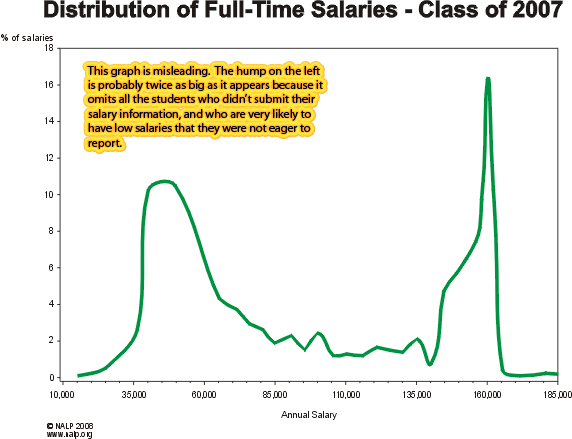 Sorry that I haven't had too many "feature" posts for while. I have some partially completed drafts sitting around in the queue. I hope to have some longer, more interesting posts out soon.
In the meantime, I thought I'd help publicize this well known (though not well enough known) chart depicting the bi-modal distribution of starting salaries out of law school.
I was inspired by a post by Exposing the Law School Scam, which linked to an advertisement by a firm looking to pay an attorney with a decade's worth of experience, $40k!
Yes, soak in this chart 0L's - this is the career you've chosen. Here the "winners" get six figure salaries (and 80 hour work weeks), and the losers get to represent other losers fighting their 6th DWI conviction all while living at the local bus terminal.
Do you think that if you miss the cutoff for working for the big firms at OCI that you'll just "settle" for 80k working for a mid-sized firm? Guess again. You might as well prepare your resume to work for the closest Big Foot sanctuary because entry level jobs like that are equally mythical.
Tuesday, January 12, 2010
Transitioning to a Non-Legal Career
Here's a short article about trying to pursue a non-legal career. Unfortunately, it isn't very detailed, but it does encourage the job seeker to adjust his strategy.
Usually, we hope that all of our accomplishments alert an employer to our general capabilities and compatibility with a position. Unfortunately, if the way we present those accomplishments makes us look qualified for a career in a different field (e.g. law), we have a problem.
If that's the case, we have to find a way to highlight what in our background makes us a good fit for the position to which we're applying. For example, if you clerked for a judge, you should emphasize your writing and research roles rather than the area of the law in which you gained experience.
Essentially, our resumes need to be a sales pitch as to why the employer should hire us. It should not simply be an autobiography that lets us bask in our own achievements. We always need to be sure to spin our experience to fit the position for which we're applying.
In other words, I think the article is telling us to lie...(j/k - I think).
Subscribe to:
Posts (Atom)


 Posts
Posts


